Monday, 30 March 2020

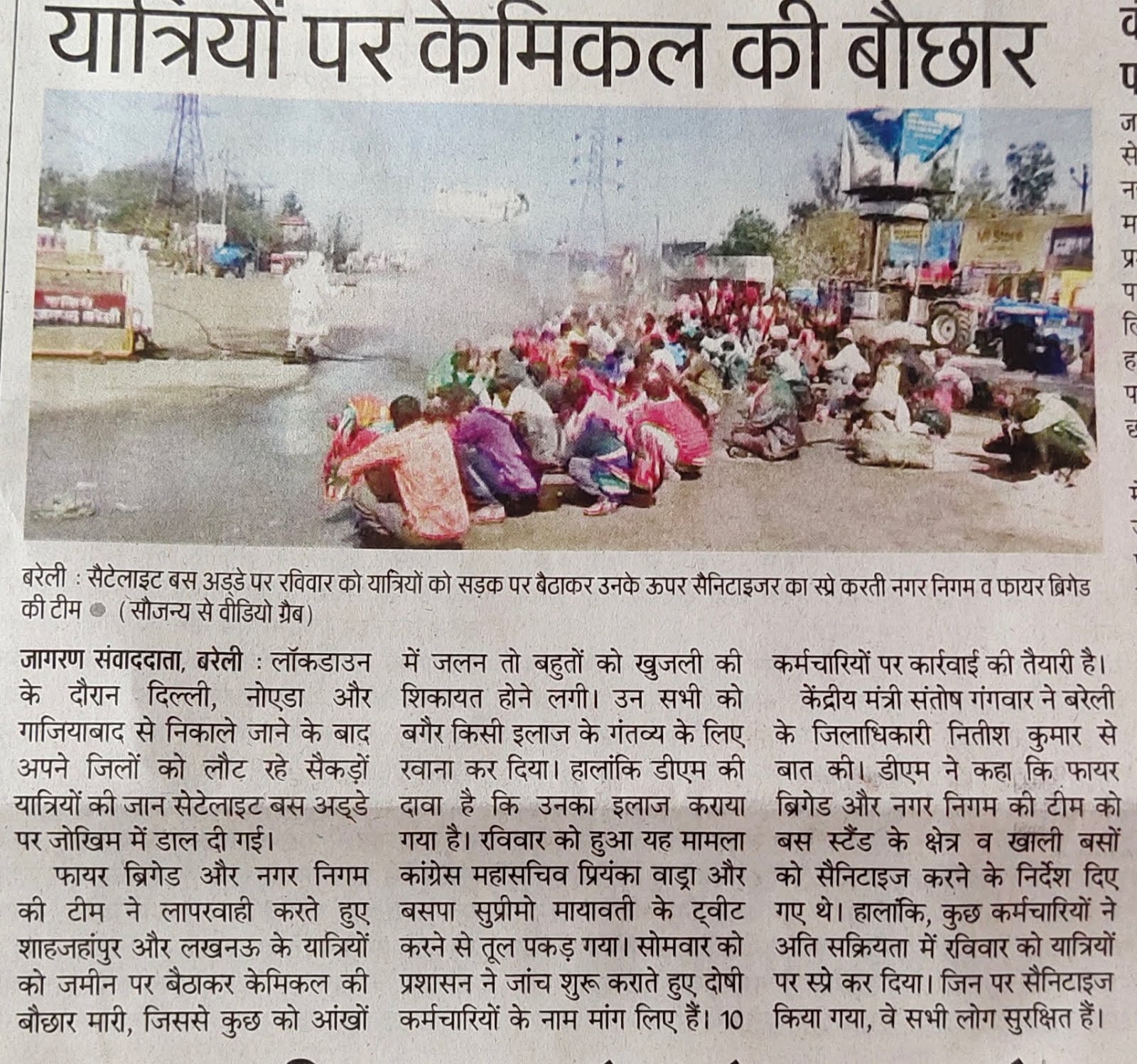
बरेली जिला उत्तर प्रदेश में मजदूरों को सेनेटाइज करने के लिए कैमिकल का बौछार किए जाने की शिकायत के संदर्भ में ।


---------- Forwarded message ---------
From: JMN PVCHR <jmn.pvchr@gmail.com>
Date: Tue, Mar 31, 2020 at 11:52 AM
Subject: बरेली जिला उत्तर प्रदेश में मजदूरों को सेनेटाइज करने के लिए कैमिकल का बौछार किए जाने की शिकायत के संदर्भ में ।
To: <cr.nhrc@nic.in>, <jrlawnhrc@hub.nic.in>
Cc: Dr. Lenin Raghuvanshi <lenin@pvchr.asia>


सेवा में 
अध्यक्ष 
राष्ट्रीय मानवाधिकार आयोग 
नई दिल्ली

विषय -  

माननीय महोदय,

उत्तर प्रदेश के बरेली जिला में सेटेलाइट बस अड्डे पर फायर ब्रिगेड और नगर निगम की टीम द्वारा लॉकडाउन के दौरान पैदल ही घर लौट रहे मजदूरों को बीच सड़क पर बिठाकर सड़क सफाई के लिए बनाए गए कैमिकल (बिलीचिंग पाउडर के घोल)  से सेनेटाइज करने के नाम पर बौछार डालकर नहला दिया गया । मजदूरों से इस प्रकार का व्यवहार अमानवीय है । 
विदित हो कि, इन मजदूरों पर कैमिकल के दुष्प्रभाव का बिना किसी चिकित्सकीय जांच किए ही भेज दिया गया जबकि यह कैमिकल बिलीचिंग पाउडर का घोल था, जो कि, सड़क की सफाई के लिए बनाया गया था कृपया आप महोदय अपने संज्ञान में लेवें, जिससे दोषी अधिकारियों और कर्मचारियों के विरुद्ध उचित कार्यवाही हो सके । संलग्न (दैनिक जागरण 31 मार्च 20 न्यूज)

प्रार्थिनी 
श्रुति नागवंशी 
मैनेजिंग ट्रस्टी 


--

People's Vigilance Committee on Human Rights (PVCHR)
An initiative of Jan Mitra Nyas ISO 9001:2008
SA 4/2 A Daulatpur, Varanasi - 221002 India
Like us on facebook: http://www.facebook.com/pvchr

Subject: Impact of regulations and restrictions issued to contain the COVID-19 pandemic on migrant workers.

To,

The Chief Secretary,
Government of Uttar Pradesh
Lucknow.

Mr. Chief Secretary,

Subject: Impact of regulations and restrictions issued to contain the COVID-19 pandemic on migrant workers.

1.     The undersigned are organizations having a keen interest in the welfare of migrant workers in India. PVCHR is membership based human rights movement working for realization of preamble of Indian constitution at grassroots level and its work has been recognized with awards like Gwangju Human Rights Award (2007), the ACHA Star Peace award (2008, the International Human Rights Prize of the city of Weimar (2010),Special Mentions Prize of Human Rights of The French Republic (2018),Public Peace Prize(2018) and Karmaveer Maharatna Award (2019). VOP is one of largest network of UP on child right supported by one of most credible donor CRY.
    
2.     With the outbreak of COVID-19, the entire country has been put under movement restrictions to facilitate self-isolation/social distancing in order to mitigate the spread of the pandemic. This is a necessary inconvenience that needs to be borne by this country in order to combat this new threat to our national health. However, it would not be out of place to point out that there are certain sections of our community who are particularly vulnerable to the consequences of these movement restrictions. A holistic approach to respond to the present pandemic would require that special provisions are made for these sections of our community in order to ensure that the nation is able to assist the Government with the response.

3.     Migrant workers are workmen who have moved from one state in India to another State in order to take up employment. Their employment and migration are governed under the Interstate Migrant Workmen Act 1979 ("IMWA"). Their employment in another State is not permanent but is specific to the project or undertaking post which they will return to their native State. Many workmen migrate from one State to another leaving behind their families who are supported by payments which are sent by these workmen. Migrant Workers further do not enjoy the security of sustained employment, for their wages are often calculated on a daily/piece rate basis.  Presently, many migrant workers are employed in the construction and agricultural sectors. In the event there is an impact on these sectors, there will be a consequent impact on the livelihoods and the family eco-systems of these workers.

4.     After the implementation of the Nationwide COVID-19 Lockdown, distressing reports are emerging in the National and International press about large numbers of migrant workers walking back to their hometowns in other states. Due to the absolute closure of India's public transport systems, including the railway and airspace,these workers have resorted to walking back to their hometowns on foot and are collecting at State Borderposts attempting to get back to their hometowns. This will no doubt have a serious repercussion on the efficacy of the social distancing measures that are being put in place, for these measures are aimed to prevent just this sort of inter-state movement.

5.     The workers though are migrating out of economic necessity and hardship. Due to the lockdown restrictions, their industries have come to a grinding halt and when there is no work, unfortunately for a daily wager, there is often no pay. Without economic support, these migrants will no longer have a place to stay or enough means to provide for themselves and their families if they stay where they are. These economic circumstances are forcing them to undertake this journey to their hometowns.

6.     The 2011 Census estimated that there are approximately 139 Million internal migrants in India[1] which would mean they constitute approximately 10% of India's 1.3 Billion population. A movement of this 10% number across the country, at a time, where isolation is demanded of every resident, would not just be highly counter productive but could jeopardise the entire set of isolation measures that are presently in place. Further, since the migrant workers are returning to their hometowns. There is a risk they will carry COVID-19 from India's urban areas to India's rural areas, where there may not be enough health infrastructure in place to handle a crisis of the magnitude of COVID-19.

7.     We wish to submit that Migrant Workers actively contribute to the economic development and prosperity of the State. They fill the labour gaps and in turn allow the State to continue with the task of development. The State has a particular duty of care to ensure that these vulnerable people, who are guests in this State, are adequately provided for in a time of crisis. 

8.     Consequently, we state that any response either under the Disaster Management Act, 2005 or the Epidemic Diseases Act, 1897 must make special provisions for migrant workers, while factoring in a pessimistic view of the period for which this lockdown will be in place.

9.                        We accordingly request that your office urgently intervene to take the following steps in order to protect not just the Migrant Workers but also ensure the integrity of the nationwide measures are maintained:

a)     Issue fresh directions or use existing mechanisms under existing Rent Control Laws to prevent the eviction of tenants on the ground of non-payment of rent till this lockdown is over.
b)    Begin an urgent ad-hoc enrolment of all residents in a state, who are otherwise not eligible, into that State's Public Distribution System.
c)     Migrant Workers may be provided with subsidised ration during their lockdown period based on showing their passbooks issued under the IMWA or on a self-declaration basis.
d)    Migrant Workers should be treated on par with other state residents for the purpose of any benefit or scheme rolled out by the State Government during the period of the lockdown.
e)     Migrant Workers should further be provided with a subsistence allowance of at least half of the monthly prevailing minimum wage for manual work in the Construction/Agriculture industries for the period of the lockdown. This may be done via direct cash transfer to the bank accounts of these workers.

10.                        We make this urgent request on behalf of the 10% of India, who are internal migrants and are particularly vulnerable in this time. Our organizations remain available at your convenience to assist further with the implementation of the measures described above.

11.                        We can come together as a nation-state and fight COVID-19 in a just, fair and equitable manner.


Sincerely


With Kindest regards,

Lenin Raghuvanshi
Founder and Executive Director, PVCHR (www.pvchr.asia)

Shruti Nagvanshi
Convenor, Voice of People (VOP)


--
Lenin Raghuvanshi
Founder and CEO
People's Vigilance Committee on Human Rights (PVCHR)
An initiative of Jan Mitra Nyas ISO 9001:2008
SA 4/2 A Daulatpur, Varanasi - 221002 India
Mobile no.+91-9935599333
Like us on facebook: http://www.facebook.com/pvchr

Impact of regulations and restrictions issued to contain the COVID-19 pandemic on migrant workers.

To,
The Home Secretary
Ministry of Home Affairs
North Block
New Delhi - 110001
India

Mr. Home Secretary,

Subject: Impact of regulations and restrictions issued to contain the COVID-19 pandemic on migrant workers.

1.   The undersigned are organizations having a keen interest in the welfare of migrant workers in India. PVCHR is membership based human rights movement working for realization of preamble of Indian Constitution on grassroots level and its work has been recognized with awards like Gwangju Human Rights Award (2007), the ACHA Star Peace award (2008, the International Human Rights Prize of the city of Weimar (2010),Special Mentions Prize of Human Rights of The French Republic (2018),Public Peace Prize(2018) and Karmaveer Maharatna Award (2019). VOP is one of largest network of UP on child right supported by one of most credible donor CRY.

2.   With the outbreak of COVID-19, the entire country has been put under movement restrictions to facilitate self-isolation/social distancing in order to mitigate the spread of the pandemic. This is a necessary inconvenience that needs to be borne by this country in order to combat this new threat to our national health. However, it would not be out of place to point out that there are certain sections of our community who are particularly vulnerable to the consequences of these movement restrictions. A holistic approach to respond to the present pandemic would require that special provisions are made for these sections of our community in order to ensure that the nation is able to assist the Government with the response.

3.   Migrant workers are workmen who have moved from one state in India to another State in order to take up employment. Their employment and migration are governed under the Interstate Migrant Workmen Act 1979 ("IMWA"). Their employment in another State is not permanent but is specific to the project or undertaking post which they will return to their native State. Many workmen migrate from one State to another leaving behind their families who are supported by payments which are sent by these workmen. Migrant Workers further do not enjoy the security of sustained employment, for their wages are often calculated on a daily/piece rate basis.  Presently, many migrant workers are employed in the construction and agricultural sectors. In the event there is an impact on these sectors, there will be a consequent impact on the livelihoods and the family eco-systems of these workers.

4.   After the implementation of the Nationwide COVID-19 Lockdown, distressing reports are emerging in the National and International press about large numbers of migrant workers walking back to their hometowns in other states. Due to the absolute closure of India's public transport systems, including the railway and airspace,these workers have resorted to walking back to their hometowns on foot and are collecting at State Border posts attempting to get back to their hometowns. This will no doubt have a serious repercussion on the efficacy of the social distancing measures that are being put in place, for these measures are aimed to prevent just this sort of inter-state movement.

5.   The workers though are migrating out of economic necessity and hardship. Due to the lockdown restrictions, their industries have come to a grinding halt and when there is no work, unfortunately for a daily wager, there is often no pay. Without economic support, these migrants will no longer have a place to stay or enough means to provide for themselves and their families if they stay where they are. These economic circumstances are forcing them to undertake this journey to their hometowns.

6.   The 2011 Census estimated that there are approximately 139 Million internal migrants in India[1] which would mean they constitute approximately 10% of India's 1.3 Billion population. A movement of this 10% number across the country, at a time, where isolation is demanded of every resident, would not just be highly counter productive but could jeopardise the entire set of isolation measures that are presently in place. Further, since the migrant workers are returning to their hometowns. There is a risk they will carry COVID-19 from India's urban areas to India's rural areas, where there may not be enough health infrastructure in place to handle a crisis of the magnitude of COVID-19.

7.   Consequently, we state that any response either under the Disaster Management Act, 2005 or the Epidemic Diseases Act, 1897 must make special provisions for migrant workers, while factoring in a pessimistic view of the period for which this lockdown will be in place.

8.   We accordingly request that your office urgently intervene to take the following steps in order to protect not just the Migrant Workers but also ensure the integrity of the nationwide measures are maintained:

a)   Direct the State Governments to begin an urgent ad-hoc enrolment of all residents in a state, who are otherwise not eligible, into that State's Public Distribution System.
b)   Direct that Migrant Workersbe treated on par with other state residents for the purpose of any benefit or scheme rolled out by the State Governmentsduring the period of the lockdown in exercise of any of the powers under the Disaster Management Act, 2005 or the Epidemic Diseases Act, 1897.
c)   Make available sufficient funds by way of grants or loans to the State Governments to ensure that Migrant Workers should further be provided with a subsistence allowance of at least half of the monthly prevailing minimum wage for manual work in the Construction/Agriculture industries for the period of the lockdown. This may be done via direct cash transfer to the bank accounts of these workers or by pre-paid payment instruments.
d)   District Administrations should be empowered to grant to migrant workers an inter-state movement pass, where the worker is able to satisfy the District Administration that there is an urgent need for the worker to travel. The worker may then be tested for COVID-19 and upon there being a negative result, the District Administration in coordination with the State Government and the Ministry of Railways/Ministry of Road Transport, may proceed to make arrangements for special railway/bus services to take these workers home at designated intervals. The workers upon reaching their hometowns should be subject to self-isolation/quarantine and monitored by the Gram Panchayat/District Administration in order to ensure COVID-19 doesn't spread to rural India.

9.   We make this urgent request on behalf of the 10% of India, who are internal migrants and are particularly vulnerable in this time. Our PVCHR and VOP remains available at your convenience to assist further with the implementation of the measures described above.

10.               We can come together as a nation-state and fight COVID-19 in a just, fair and equitable manner.


Sincerely

With Kindest regards,

Lenin Raghuvanshi
Founder and Executive Director, PVCHR (www.pvchr.asia)

Shruti Nagvanshi
Convenor, Voice of People (VOP)


--
Lenin Raghuvanshi
Founder and CEO
People's Vigilance Committee on Human Rights (PVCHR)
An initiative of Jan Mitra Nyas ISO 9001:2008
SA 4/2 A Daulatpur, Varanasi - 221002 India
Mobile no.+91-9935599333
Like us on facebook: http://www.facebook.com/pvchr

Urgent: Additional Proposals for the Short-term Relief of Vulnerable Workers and Populations Deeply impacted by Strategies to Contain the Spread of the Corona Pandemic

To

  1. The Honorable Prime Minister of India
  2. Honorable Chief Ministers of all States


Urgent: Additional Proposals for the Short-term Relief of Vulnerable Workers and Populations Deeply impacted by Strategies to Contain the Spread of the Corona Pandemic


Dear Sir/Madam


As the corona pandemic, and measures to contain it, unfolds, we are witnessing a humanitarian and economic crisis of unprecedented proportions. The Central government has announced a Rs. 1.7 trillion package aimed at alleviation of the impact of the lockdown on the poor (PMGKY) over the next three months. It is also heartening that a number of states have announced additional measures and relief packages varying in nature and scale. These measures will have to be scaled up with immediate and unconditional financial and other support from the national government given the magnitude of the crisis that the country as a whole is facing.  Therefore we appeal to the Government of India and all the State Governments to initiate urgent additional measures that are required to address critical gaps that exist in the short-term relief measures announced so far. These are listed below:


1.      Immediate measures by governments to provide for food and subsistence requirements

Cash and kind assistance, and food for the homeless, landless, primitive tribe and most distressed, is urgently required by the poor in the informal economy who have lost jobs and incomes. We propose the following:

a.      Cash Income Support: The stoppage of employment and incomes for those in the informal economy urgently necessitates cash income support. The Centre's announcement of transferring Rs. 500 per month to each JDY woman account holder is grossly insufficient. The Centre and States together should try and ensure a minimum transfer over the next three months of at least Rs 6000 per month with a major part borne by the Central Government. All households who do not have a tax payer or a formal worker should be eligible to receive the cash transfer through bank accounts. Assuming that about 20 crore households will require such assistance; the total quantum of assistance will be about Rs 3, 60,000 crores over three months.

b.      Rations: There is a growing consensus among central/state governments that PDS rations be increased to ten kg per person per month and should also include other essentials – including pulses, oil, soaps, gur/sugar. The Central government has declared 5 kg free rations plus 1 kg free pulses as supplementary monthly ration. Many state governments have announced free basic or enhanced rations. We request all state governments may be asked provide free basic rations (with supplements) free of cost, so that the entire rations can be free for the eligible households.

c.       As model employers, all central and state government establishments, statutory and public sector organisations should immediately announce that all contract and outsourced employees will continue to be paid full wages during the lockdown. Government of India should send a similar message to all incorporated private enterprises in this hour of survival crisis being faced by workers.

d.      Some states have already announced increases in old age pensions and ex gratia transfers to workers, including construction workers. We welcome these steps as a good beginning. But States should advertise the mechanism they are following to put their announcement into practice. The Central government has also declared that it will issue a direction to all states to make ex gratia transfers to all construction workers registered under the Boards. This should be done immediately and all states should make immediate ex gratia payments to the registered construction workers through the Construction Workers' Welfare Fund. All other Central Welfare Funds should be utilized to provide immediate assistance to other workers such as Bidi workers and similar sources should be utilized for other categories of unemployed workers.

e.      In a time of an epochal crisis such as the present one, special effort has to be made to make assistance to be provided on a non-discriminatory basis, and covering those who for some reason have been wrongly excluded. Special efforts and drives should be carried out to include scheduled castes and tribes, persons of third gender, migrants etc. Not all poor households, particularly migrants, have functional bank accounts, and proper mechanisms need to be evolved on how cash assistance be designed for them. Similarly, special efforts should be put in place to identity and provide rations to landless households/individuals who do not have ration cards or whose ration cards have been deleted mistakenly and to identify and include persons who have been left out of the NSAP list.


2.      Urgent steps to deal with stranded populations

a.      The sudden lockdown has created a serious humanitarian and public health crisis involving vulnerable migrant workers and their families. Casual migrant workers, particularly those in construction, manufacturing, and transport workers – who could number 50 to 60 lakh - are highly impacted by the crisis and most want to head back immediately to their source villages, even under great odds. Many of them have accompanying family workers, so that this number is likely to spill over, in our judgement,  to 10 to 15 million. If the lockout prolongs, migrant self-employed daily earners and informal regular wage workers may join these workers. Already lakhs of workers and their families, and also students, are on the roads, prepared to travel long distances. These numbers could mount if the lockdown extends.

b.      The Central government has directed that there should be no movement of migrants and that district and state boundaries be sealed. In our view, this will exacerbate the humanitarian crisis and may result in crowding and consequential serious public health issues.

c.       We believe that migrants could be encouraged to stay back but not coerced. The facilities and space at the disposal of the Centre and the States should be utilized such that there is no crowding for migrants who stay back, and food and subsistence facilities should be made available. State Governments should immediately summon all facilities, public and private, for sheltering the migrant workers as well as to quarantine and create new treatment facilities.  These could include all academic and public institutions such as schools and colleges, hotels, hostels, marriage halls, guest houses,  and similar facilities.  Government of India should also appeal to all places of worship to provide their facilities for health care and/or sheltering migrant and indigent population.

d.      Many state governments including Kerala and Delhi have ramped up community feeding programmes for migrant and homeless populations.  Kerala has already opened more than 4000 camps for sheltering the migrant workers. We would request all states should step in with similar measures. Government of India should announce that it will defray the cost of sheltering and feeding migrant workers and their families as a matter of national responsibility given their contribution to the national economy. The private sector should be asked to contribute to this effort generously.

e.      The NDMA should immediately and urgently oversee a coordinated and coordinated arrangement for transporting migrant workers who are already on the road by special trains, buses, or trucks. This should be done on a war footing. The Government should extend the transport vehicles and personnel of the paramilitary forces to the affected State Governments.  If necessary the help of the Army should be made available.  In our view, migrants will be better off and safer in their home environments than if they are kept back in crowded and congested areas, separated from their families and communities.

f.        Some state governments have imposed compulsory isolation of 14 days on all returnees in public shelters. We do not wish to comment on the desirability of putting all returnees under compulsory isolation in public facilities at this stage of disease transmission. In our view self-isolation at home under community supervision may be a better solution, if this is considered necessary to contain the spread of the pandemic. Source states should issue clear advisories on the safety and health of the returnees and the host populations and involve the PRIs and local bodies.

g.      Dedicated multi-lingual help lines for migrants should be set up immediately in all states and committees should be set up with the participation of organisations having experience of working with migrant workers. In this connection, we have already noted the App developed and made available by the Government of Kerala (GoKDirect) with information provided in 6 languages.

h.      The Special Disaster Relief Fund created by the Prime Minister should be used for providing assistance to the migrants and for facilitating their stay, transport, and safe relocation to their homes, as the case may be.


3.      Measures to ensure safe harvesting and post-harvesting activities in rural areas

We are already in the middle of the Rabi harvesting season when standing crops have to be harvested, processed, and sold. Some states have already issued notification declaring harvesting and post-harvesting activities, including mandi operations, as essential services. The Government of India has also issued a second addendum to the lockdown guidelines exempting essential farming related operations, including movement of machinery. Clear notifications should be issued by all states, which should safety guidelines.  Procurement at MSP and storage needs by the FCI and State FCIs needs to be enhanced to prevent a famine like condition from evolving.


4.      Support of civil society and voluntary workers be enlisted in identifying vulnerabilities and assisting with the deliverables

In all natural disasters in the past, civil society has played an important and prominent role in relief and rehabilitation. As in any natural disaster, the government's capacity and preparedness to face the outcomes of the pandemic has to be augmented by that of civil society. The Government of India has set up a portal for the enlistment of individuals and organisations. This is also already happening in many states.  The Government of Kerala has already announced the formation of a Community Volunteer Force with a strength of around 2.4 lakh persons to provide support services at the Village Panchayat and Municipal level. Within a couple of days, more than one lakh persons have already registered through an online registration. The Jharkhand Government has also enlisted the support of volunteers. All state governments should set up committees at the Village Panchayat, Block, District and State levels, start on-line portals, and organisations could indicate the nature of the resources that could muster, areas of work, support required etc. Panchayat leaders and officials and sub-district health staff should be educated and trained at the very earliest.


5.      Ensuring the safety, security, and welfare of the front-line workers, who are at risk

At present, the Central and state governments have to equip the frontline health workers and the hospitals, which should remain the top most priority for all governments, but frontline workers also include others engaged in essential services on behalf of governments (such as sanitation workers), or private firms (delivery workers, workers in chemist shops etc.) who also are at greater risk and under hardship. States should announce specific measures for the safety, job security, and welfare of all such workers and private employers should also follow up.


6.      Release of prisoners

Some states such as Delhi, UP, Bihar and Maharashtra have already announced the release of prisoners from overcrowded jails addressing public health concerns and releasing precious resources for other purposes. State should release under-trial persons and political persons, or those in jails for minor issues, in order to immediately decongest prisons and jails.


7.      Revised NDMA Guidelines on the Lockdown suitable for India's Context

The NDMA Guidelines have been revised from time to time through addendums. They should be comprehensively revised to allow people to deliver, as well as access essential services, while maintaining social distancing and other public health related measures necessary under the present circumstances. Guidelines and explanatory videos should be cognizant of the nature of urban Indian and rural society, levels of homelessness, overcrowding, illiteracy etc. and large scale educational campaigns should be carried out and concerns addressed through press conferences on a daily basis. Police are themselves frontline workers performing their duties under difficult circumstances but clear instructions should be issued to police in the light of these detailed guidelines not to harass distressed citizens who are either trying to provide, or access, essential goods and services.


8.      Larger Support from the GoI is the Need of the Hour

Government of India as a sovereign institution alone has the fiscal capacity to raise significant financial resources. It should do so immediately by a three to four fold increase of the current relief package. It should also play a clearer and stronger role interstate coordination and mobilization of non-fiscal resources. This was sadly lacking with respect to the stranded workers in cities and destination states.


We request you to urgently consider the above proposals and to take the necessary decisions at your level.


With Kindest regards,


Lenin raghuvanshi

Founder and Executive Director, PVCHR (www.pvchr.asia)

https://en.wikipedia.org/wiki/Lenin_Raghuvanshi


Shruti Nagvanshi

Convenor, Voice of People (VOP)

www.shrutinagvanshi.com


--
Lenin Raghuvanshi
Founder and CEO
People's Vigilance Committee on Human Rights (PVCHR)
An initiative of Jan Mitra Nyas ISO 9001:2008
SA 4/2 A Daulatpur, Varanasi - 221002 India
Mobile no.+91-9935599333
Like us on facebook: http://www.facebook.com/pvchr

Support to migrant worker


जब खाने की समस्या नहीं थी तो अंकरी घास क्यों खा रहे थे मुसहर?

ख़बर के अनुसार बनारस की कोइरीपुर मुसहर बस्ती में लॉकडाउन के चलते पिछले तीन दिनों से लोगों के घर चूल्हे नहीं जले. पेट की आग बुझाने के लिए लोग घास खा रहे हैं. मुसहरों के पास सैनेटाइजर और मास्क की कौन कहे, हाथ धोने के लिए #साबुन तक नसीब नहीं है.

कमोबेश यही हाल पिंडरा की तीनों मुसहर बस्तियों का है. औरांव, पुआरीकला, आयर, बेलवा की मुसहर बस्तियों में लोगों को भीषण आर्थिक तंगी झेलनी पड़ रही है. राशन न होने के कारण मुसहरों के घरों में चूल्हे नहीं जल पा रहे हैं.

#मुसहर समुदाय आज भी समाज में सबसे आखिरी पायदान पर खड़ा है. इस समुदाय में गरीबी और अशिक्षा भयानक है. इस समुदाय के लोग खेतों में मजदूरी करते हैं या मांगकर खाते हैं. सरकार की तमाम कोशिशों के बावजूद इस समुदाय में विकास की रोशनी अभी तक नहीं पहुंची है.

वाराणसी में बीते 25 सालों से लेनिन रघुवंशी और श्रुति रघुवंशी मुसहर समुदाय के लोगों के अधिकारों और हितों के लिए संघर्ष कर रहे हैं. दोनों पति-पत्नी हैं और डॉक्टरी की पढ़ाई के बाद उन्होंने इनके लिए काम करना ही अपना मकसद बना लिया.

#न्यूजलॉन्ड्री से बात करते हुए लेनिन रघुवंशी अख़बार में छपी ख़बर को जायज बताते हुए कहते हैं, ‘‘इसमें कोई दो राय नहीं की वहां मुसहरों की बुरी स्थिति थी. जिलाधिकारी ने बेवजह इस पूरे मामले को बढ़ा दिया. जहां तक इस घास की बात है तो यह बिना बोये उगता है. एक समय में लोग इसे खाते थे. 20 से 25 साल पहले तक. लेकिन बाद में आया कि इसे खाने से आंखें खराब हो जाती हैं. आज अगर कोई इसे खाता हो तो सिर्फ मज़बूरी में. जब मुसहर समुदाय के लोगों के पास खाने को नहीं था तो उनके बच्चे नमक से घास खा रहे थे. यह खाने के लिए नहीं होता है.’’

#रघुवंशी कहते हैं, ‘‘मीडिया में ख़बर आने के बाद लगभग 700 मुसहर परिवारों को प्रशासन ने राशन उपलब्ध कराया है. लोगों की स्थिति अब समान्य हो गई है. लेकिन सबको मालूम है कि मुसहरों की स्थिति बहुत बेहतर नहीं है. हमारी कोशिश से यहां के कुछेक मुसहर पढ़ाई कर पाए है और एकाध विदेश कमाने जा सके हैं.’’

इस पूरे मामले में प्रशासन की नोटिस की समयसीमा अब समाप्त हो चुकी है. अख़बार अपने ख़बर के साथ खड़ा है. अब नोटिस के अनुसार जिलाधिकारी विधिक कार्यवाही कर सकते हैं. इसी बीच इस मामले में राष्ट्रीय मानवाधिकार आयोग में याचिका भी दी गयी है.